
Every UAE business has competitors a few minutes away, in the same mall, on the same portal or in the same search results. A competitor analysis shows how you compare on what customers actually care about, and where you can win. This guide walks through a practical competitor analysis in six steps, lists what to compare and where to find the information in the UAE, and gives a simple template you can use straight away.
Research and Analytics
Competitor Analysis: A Practical Guide for UAE Businesses (with Template)
11 min read·16 October 2026·
What is a competitor analysis?
A competitor analysis is a structured comparison of your business with the companies your customers could choose instead. It covers what competitors offer, how they price and promote it, how they serve customers and what customers say about them. The aim is not to copy competitors but to find the gaps where you can be clearly better.
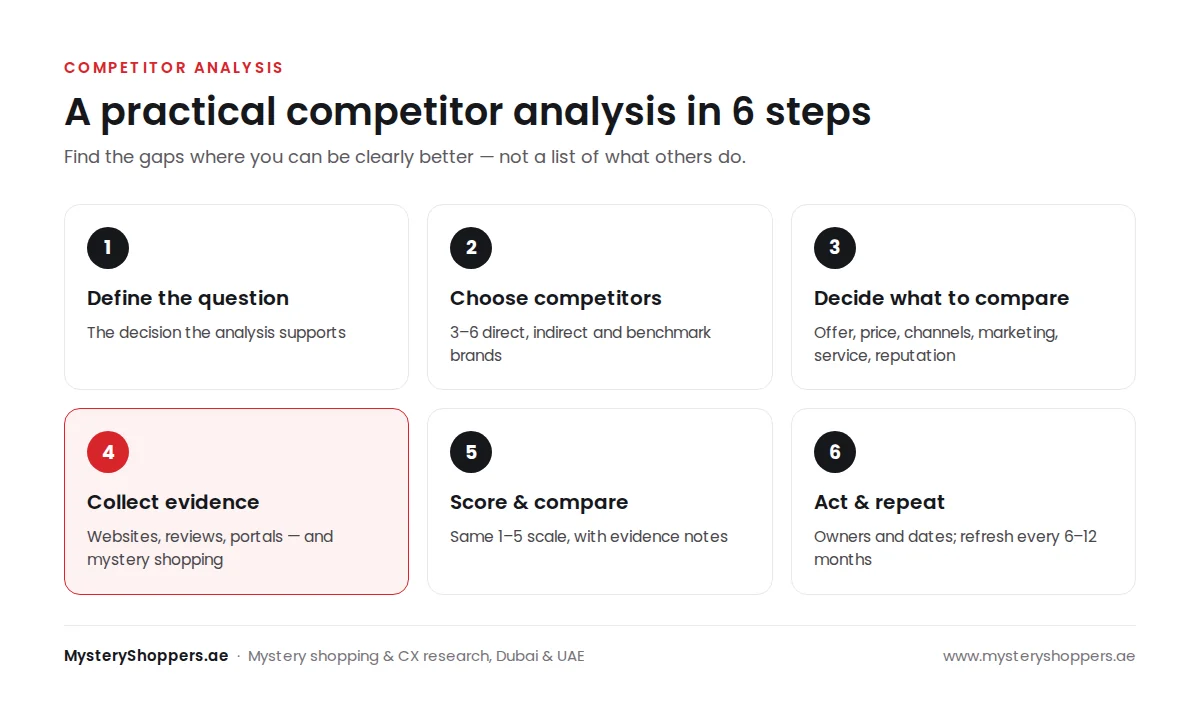
Step 1: Define the business question
Start with the decision the analysis will support. For example: why are we losing walk-in sales to the store next door, how should we price a new service, or which competitor sets the standard for follow-up in our market? A clear question keeps the analysis focused and short.
Step 2: Choose the right competitors
- Direct competitors: businesses that sell the same thing to the same customers, such as another dealership for the same car segment.
- Indirect competitors: different solutions to the same need, such as delivery apps competing with dine-in restaurants.
- Aspirational benchmarks: businesses known for excellent service in another sector, useful for setting standards.
Three to six competitors is usually enough. Include the ones customers mention most often.
Step 3: Decide what to compare
- Products and services: range, quality, availability and unique features.
- Prices and offers: list prices, promotions, payment plans, fees and terms.
- Locations and channels: branches, opening hours, website, app, WhatsApp and delivery.
- Marketing: messages, social media activity, advertising and search visibility.
- Customer experience: greeting, product knowledge, waiting time, follow-up and complaint handling.
- Reputation: Google ratings and review themes, social comments and word of mouth.
Step 4: Collect the evidence
- Websites, social media and online ads show positioning, offers and messaging.
- Google Maps reviews and ratings show what customers praise and complain about.
- Property portals, marketplaces and delivery apps show prices, listings and ratings in many UAE sectors.
- Public company information, press releases and annual reports cover larger competitors.
- Search results show who appears for the keywords your customers use.
- Mystery shopping shows the real customer experience: how quickly each competitor answers a call or WhatsApp message, how staff sell, and whether anyone follows up. This is the part most desk research misses; our competitor benchmarking service runs the same scenario at your business and your competitors so the results can be compared fairly.
Step 5: Score and compare
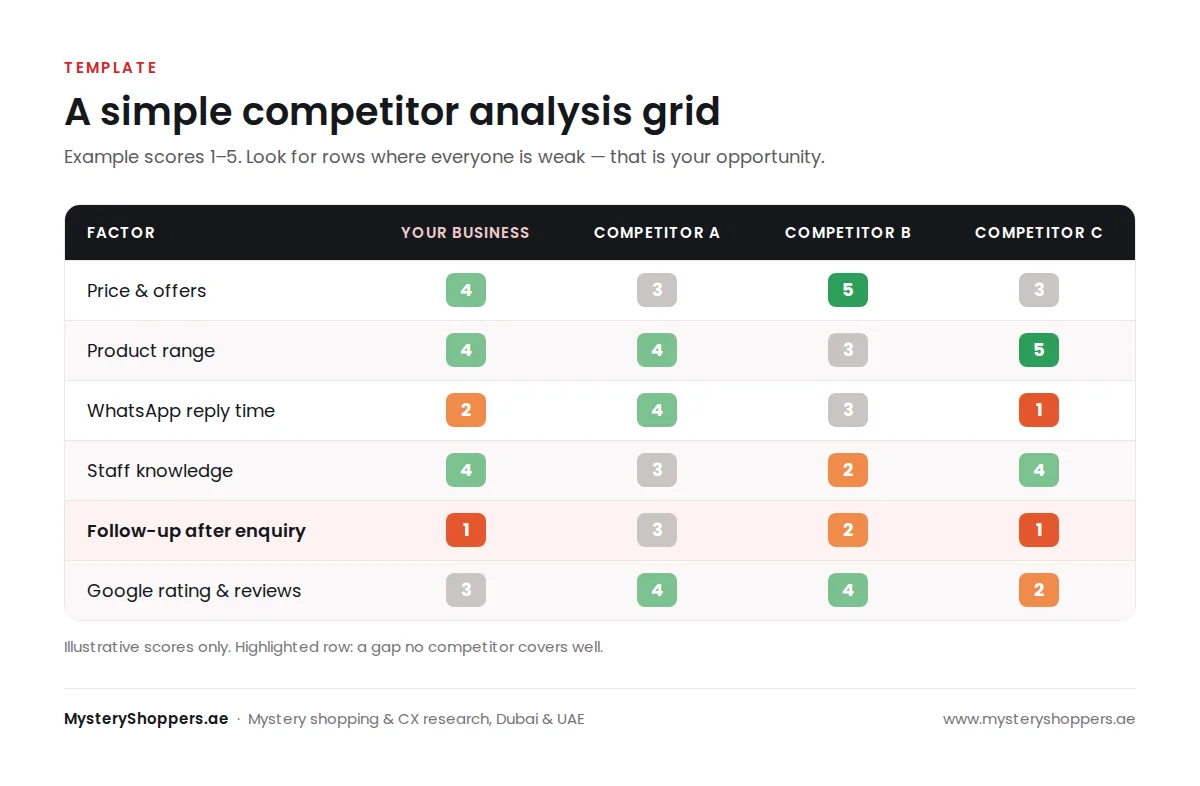
Put the findings into a simple grid with your business and each competitor as columns and each factor as a row. Score each factor on the same scale, for example 1–5, and add short evidence notes. Then look for patterns: where everyone is weak, where one competitor is clearly ahead, and where you lead.
Step 6: Turn findings into action
- Fix the gaps that matter most to customers and where competitors are clearly ahead.
- Build on the areas where you lead, and make sure customers know about them.
- Look for opportunities no competitor is serving well, such as fast WhatsApp replies or proper follow-up.
- Assign an owner and a date to each action.
- Repeat the analysis every six to twelve months, or before a major launch.
Useful frameworks
- SWOT: strengths, weaknesses, opportunities and threats, a simple way to summarise the findings.
- Perceptual map: a chart that places competitors on two dimensions customers care about, such as price and service level.
- Porter's Five Forces: a wider view of competition, including new entrants, substitutes, suppliers and buyers.
Use frameworks to organise evidence, not to replace it.
Common mistakes
- Comparing only prices and ignoring service, which is often where customers decide.
- Relying on competitors' websites, which show what they promise rather than what customers receive.
- Analysing too many competitors and too many factors, so nothing gets done.
- Doing the analysis once and never updating it.
When to get help
Desk research covers prices, offers and online presence. For an objective view of how competitors actually treat customers, from response times to sales behaviour, consider mystery shopping-based competitor benchmarking. For wider market studies, our guide to market research companies in Dubai explains which type of provider fits which question.
Frequently asked questions
What should a competitor analysis include?
Products and services, prices and offers, locations and channels, marketing, customer experience and reputation, compared across three to six competitors with evidence for each score.
How often should a competitor analysis be done?
Every six to twelve months for most businesses, and before major decisions such as a launch, a price change or a new location.
How can I compare competitors' customer service?
Through mystery shopping: trained evaluators contact or visit each competitor with the same scenario and score the experience on the same checklist, which makes the comparison fair.
Is it legal to mystery shop competitors in the UAE?
Visiting or contacting a business as an ordinary customer to observe the service is a common practice. Evaluators should behave like genuine customers, avoid misleading staff beyond the normal enquiry, and not record people without consent.
What is the difference between competitor analysis and competitor benchmarking?
Competitor analysis is the broader review of competitors' offer, prices, marketing and reputation. Competitor benchmarking measures specific performance, such as service quality or response time, against competitors using the same method.
Let's talk
Ready to see what your customers really experience?
Request a corporate proposal or book a CX consultation with our team.