
A customer journey map is a visual picture of every step a customer takes with your business, from the moment they first notice you to long after they have paid. It shows what the customer is trying to do at each stage, which touchpoints they use, how they feel and where the experience breaks. Done well, it turns vague complaints into a short list of fixes that management can act on. This guide explains how to build one step by step, using a worked example from a car showroom in Dubai.
Customer Experience
Customer Journey Mapping: A Step-by-Step Guide with a UAE Example
11 min read·7 October 2026·
Related insights
What is customer journey mapping?
Customer journey mapping is the process of documenting the experience from the customer's point of view rather than the organisation's. An internal process map shows what your teams do. A journey map shows what the customer sees, does, thinks and feels, including the steps your company does not control, such as reading reviews or asking friends on WhatsApp.
A typical journey map has five layers:
- Stages: the main phases of the journey, for example awareness, research, enquiry, visit, purchase and after-sales.
- Customer goals: what the customer is trying to achieve at each stage.
- Touchpoints and channels: the website, Instagram, phone calls, WhatsApp messages, the showroom, the invoice, the service centre.
- Emotions: how the customer feels at each step, usually drawn as a line that rises and falls.
- Pain points and opportunities: where the experience breaks, and what could be done about it.
Why journey mapping matters for UAE businesses
UAE customers move quickly between channels. Many start on Instagram or Google, send a WhatsApp message, call a branch and only then visit in person. Each channel is often run by a different team, so nobody owns the whole experience. Journey mapping makes those hand-offs visible. It is especially useful for real estate developers, automotive dealers, banks, healthcare providers and government service centres, where a single customer may deal with five or more departments.
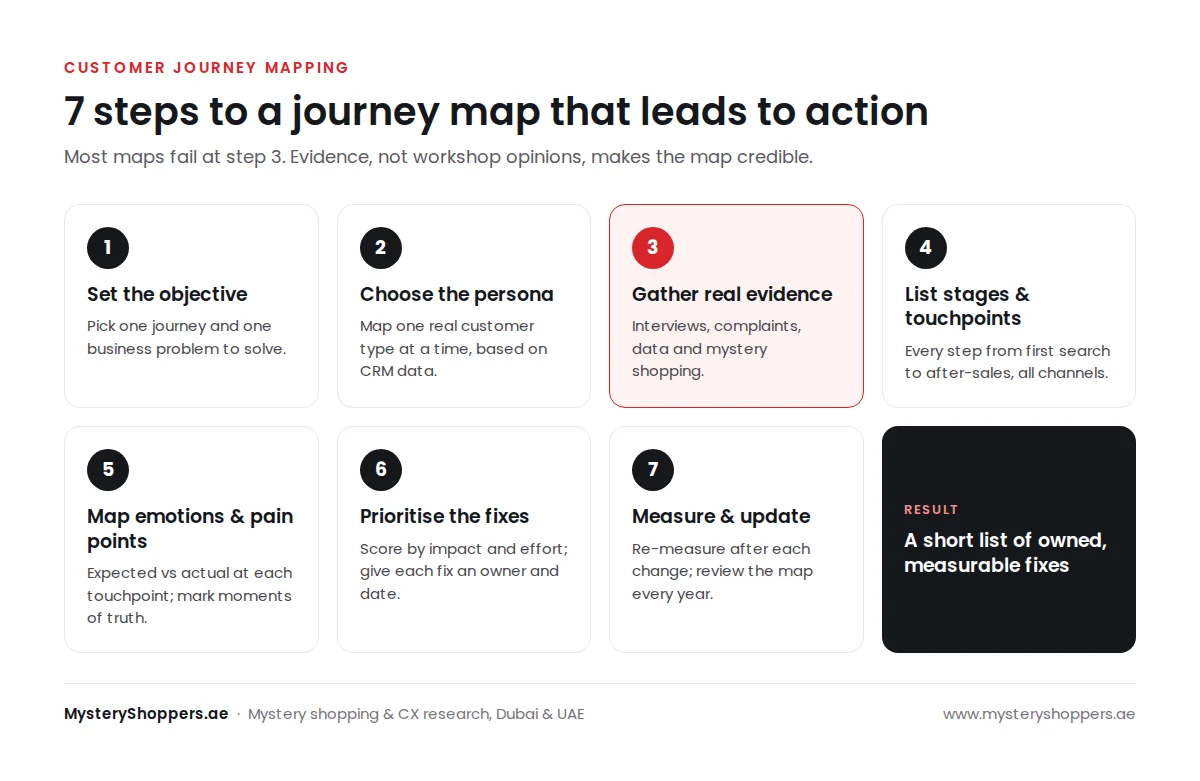
How to create a customer journey map in 7 steps
Step 1: Set a clear objective
Decide which journey you are mapping and why. "Improve customer experience" is too broad. "Find out why only a small share of online enquiries book a showroom visit" gives the map a purpose and tells you which stages matter most.
Step 2: Choose the customer persona
Map one type of customer at a time. A first-time car buyer, a fleet manager and a returning service customer have very different journeys. Base personas on real data from your CRM and sales team, not on assumptions.
Step 3: Gather real evidence
This is the step most companies skip, and it is the one that makes the map credible. Combine several sources:
- Customer interviews and satisfaction survey comments.
- Complaint logs, call recordings and WhatsApp conversations.
- Website and CRM data showing where people drop out.
- Mystery shopping, where trained evaluators go through the journey as real customers and record every step. This shows what actually happens, not what the process manual says should happen.
Step 4: List the stages and touchpoints
Write down every stage from first awareness to after-sales, then every touchpoint within each stage. Include touchpoints your company does not own, such as review sites, comparison portals and word of mouth.
Step 5: Map emotions and pain points
For each touchpoint, record what the customer expects, what actually happens and how they feel. Mark the moments of truth, where the experience either wins or loses the customer. These are usually a small number of steps, such as the first reply to an enquiry or the handover of a new car.
Step 6: Prioritise the fixes
A journey map is only useful if it leads to change. Score each pain point by its impact on customers and the effort needed to fix it, then agree an owner and a deadline for the top three to five. Quick wins, such as a faster first response on WhatsApp, often deliver results within weeks.
Step 7: Measure and update
Set a measure for each fix, for example response time, test-drive booking rate or satisfaction score, and check it again after the change. Revisit the map at least once a year, or whenever you launch a new channel or service.
Worked example: buying a car in Dubai
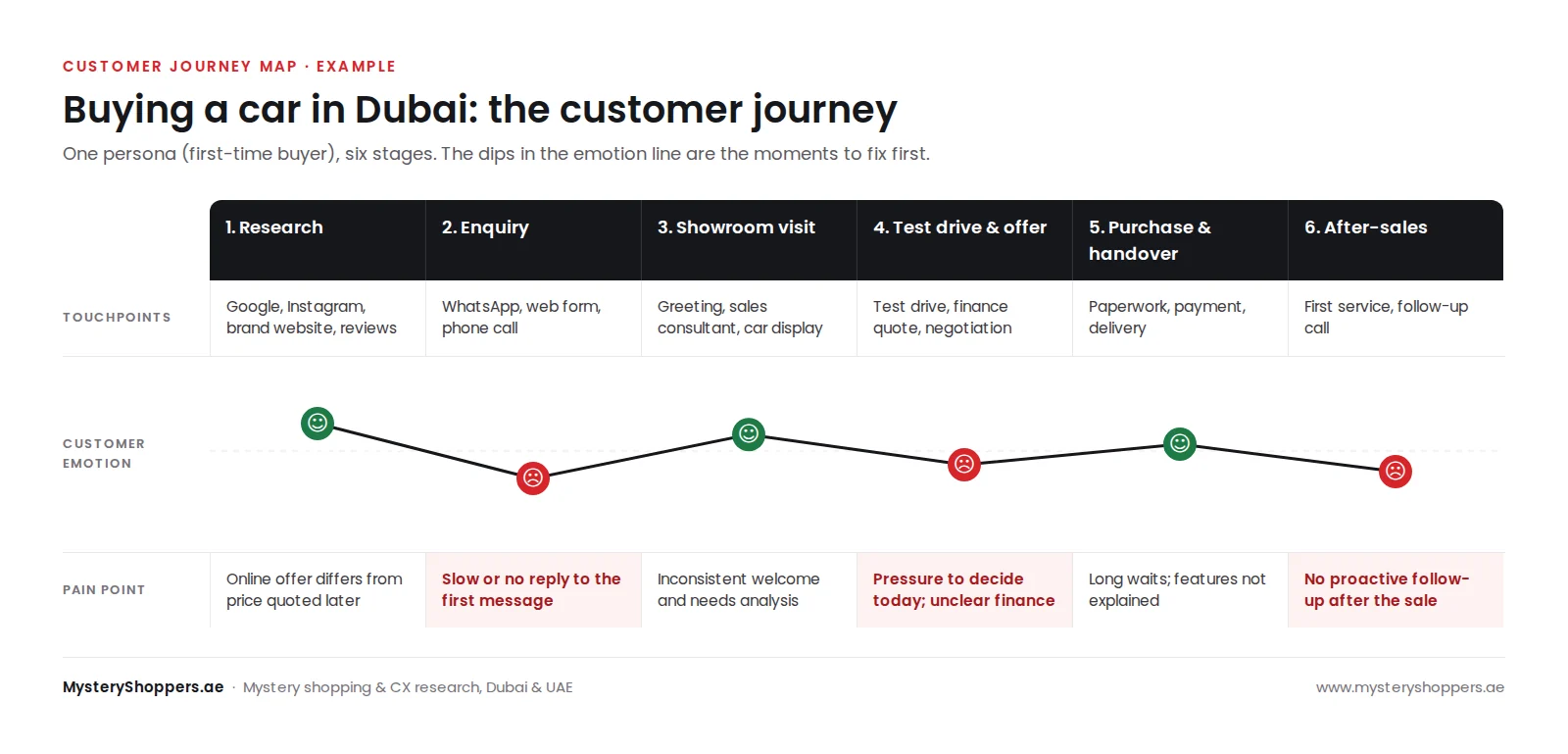
The map at the top of this guide shows a simplified journey for a first-time buyer at a car showroom in Dubai. Here is what each stage typically reveals when the journey is tested with mystery shopping:
- Research: the customer compares models online and on social media. Pain point: prices and offers on the website do not match those quoted later.
- Enquiry: the customer sends a WhatsApp message or fills in a web form. Pain point: slow or no reply, which is often the biggest single drop-out point.
- Showroom visit: the customer is greeted, shown cars and offered a test drive. Pain point: inconsistent welcome and needs analysis between sales consultants.
- Test drive and offer: the moment of truth. Pain point: pressure to decide on the day, unclear finance options.
- Purchase and handover: paperwork, payment and delivery. Pain point: long waiting times and missing explanations of features.
- After-sales: first service and follow-up. Pain point: no proactive follow-up after the sale.
In this example, the map points to three priorities: a response-time standard for WhatsApp and web leads, a consistent greeting and needs-analysis routine in the showroom, and a structured handover checklist. Each one can be measured again with a follow-up round of mystery shopping.
Common journey mapping mistakes
- Mapping the process you designed instead of the experience customers actually have.
- Building the map in a workshop without any customer evidence.
- Trying to map every customer type in one diagram.
- Ignoring digital and messaging channels, which in the UAE are often where the journey starts.
- Producing a beautiful poster that nobody owns or updates.
Tools and templates
You can start a journey map on a whiteboard, in a spreadsheet or in a collaboration tool such as Miro. The format matters far less than the evidence behind it. A simple table with the stages as columns and the five layers as rows is enough for a first version.
How MysteryShoppers.ae helps
We build customer journey maps for UAE organisations using real evidence. Our evaluators complete the journey across every channel, including website, phone, WhatsApp, social media and in-person visits, and we combine their findings with your customer feedback and data. You receive the map, the prioritised list of fixes and a way to measure progress. Request a proposal to discuss your customer journey.
Frequently asked questions
What are the 5 stages of a customer journey?
A common model uses awareness, consideration, purchase, retention and advocacy. Many businesses adapt the stages to their own sector, for example research, enquiry, visit, purchase and after-sales for a car dealer.
What is the difference between a customer journey map and a service blueprint?
A customer journey map shows the experience from the customer's side. A service blueprint adds what happens behind the scenes, including staff actions, systems and processes that support each touchpoint. Many projects start with a journey map and then build a blueprint for the stages that need fixing.
How long does it take to create a customer journey map?
A first version based on existing data can be built in a few days. A full evidence-based map with customer interviews and mystery shopping usually takes three to six weeks, depending on the number of channels and locations.
How often should a customer journey map be updated?
Review it at least once a year, and whenever you launch a new channel, product or location. Re-measure the key touchpoints after each improvement to confirm the change worked.
Can mystery shopping be used for customer journey mapping?
Yes. Mystery shopping is one of the most reliable ways to gather evidence for a journey map, because trained evaluators record what actually happens at every step, across every channel, in the same way each time.
Let's talk
Ready to see what your customers really experience?
Request a corporate proposal or book a CX consultation with our team.