
A customer satisfaction survey is only as good as its questions. Ask vague questions and you get a score nobody can act on; ask the right ones and you learn exactly which part of the experience to fix. This guide gives you 40 ready-to-use customer satisfaction survey questions grouped by purpose, a short template for most businesses, how to calculate the main scores, and the practical points that matter for surveys in the UAE, from language to WhatsApp.
Customer Experience
Customer Satisfaction Survey Questions: 40 Examples and a Ready Template
11 min read·16 October 2026·
What makes a good survey question
- It measures one thing. "Was our staff friendly and fast?" is two questions; split it.
- It is neutral. "How much did you enjoy your visit?" assumes enjoyment; "How would you rate your visit?" does not.
- It uses a consistent scale, so answers can be compared across branches and months.
- It is linked to a decision. If no one will act on the answer, remove the question.
- It is short. Most customers will answer three to seven questions; completion drops quickly after that.
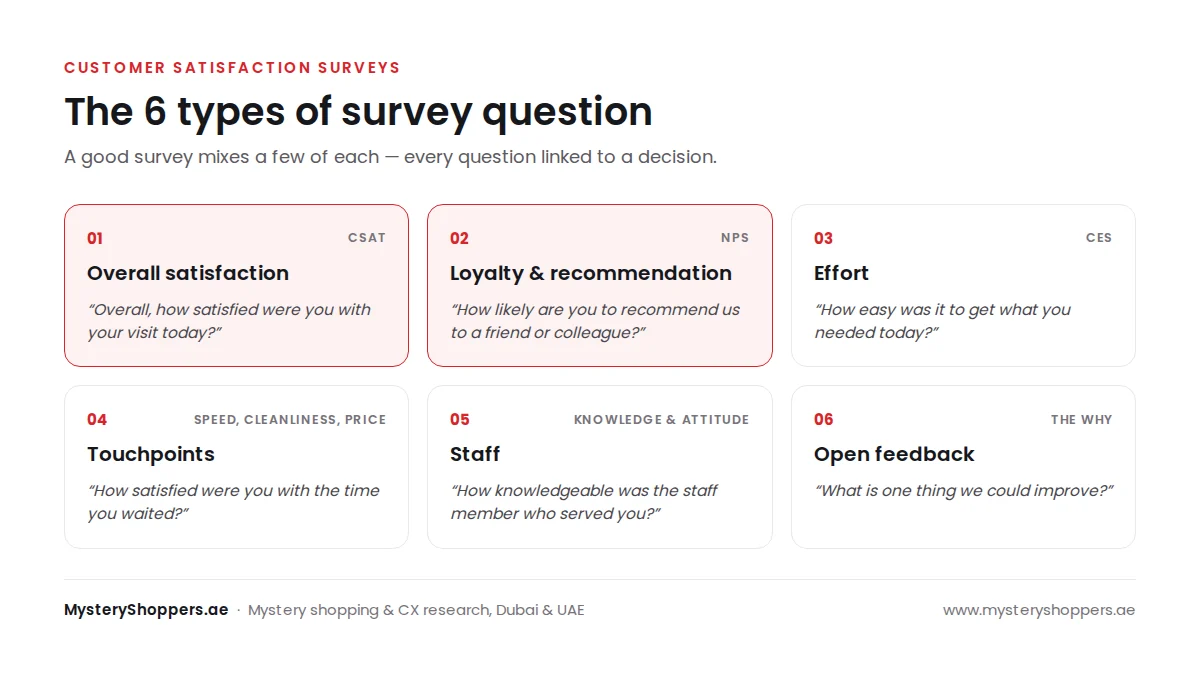
1. Overall satisfaction questions (CSAT)
- Overall, how satisfied were you with your visit today? (1–5)
- How satisfied are you with the product or service you received? (1–5)
- How well did we meet your expectations? (Much worse than expected – much better than expected)
- How would you rate the value for money? (1–5)
- How satisfied are you with your experience compared with your last visit? (Worse / the same / better)
- Did you get everything you came for today? (Yes / partly / no)
2. Loyalty and recommendation questions (NPS)
- How likely are you to recommend us to a friend or colleague? (0–10)
- What is the main reason for your score? (Open)
- How likely are you to visit or buy from us again? (1–5)
- If we were not available, where would you go instead? (Open or list)
- What would make you more likely to recommend us? (Open)
Our guide to Net Promoter Score explains how to calculate and use the recommendation score.
3. Effort questions (CES)
- How easy was it to get what you needed today? (Very difficult – very easy)
- How easy was it to find the information you needed on our website? (1–5)
- How many times did you have to contact us to resolve your request? (Once / twice / three or more)
- How easy was it to book an appointment or reservation? (1–5)
- Did you have to repeat your information to more than one person? (Yes / no)
4. Touchpoint questions
- How satisfied were you with the time you waited to be served? (1–5)
- How would you rate the cleanliness of our branch? (1–5)
- How clear was the pricing and information about offers? (1–5)
- How satisfied were you with the speed of our reply on WhatsApp? (1–5)
- How would you rate the delivery or collection experience? (1–5)
- How easy was the payment process? (1–5)
- How satisfied were you with how your complaint was handled? (1–5)
- Was your order or request completed correctly the first time? (Yes / no)
5. Staff questions
- How would you rate the friendliness of the staff who served you? (1–5)
- How knowledgeable was the staff member about our products or services? (1–5)
- Did the staff member understand what you needed? (Yes / partly / no)
- Were you able to communicate in your preferred language? (Yes / no)
- Did anyone offer further help before you left? (Yes / no)
- How professional was the staff member's appearance and manner? (1–5)
6. Open feedback questions
- What did we do particularly well today?
- What is one thing we could improve?
- Was there anything that surprised you, positively or negatively?
- Is there anything else you would like to tell us?
- May we contact you about your feedback? (Yes, with phone or email / no)
7. Questions about the customer (use sparingly)
- Is this your first visit to us? (Yes / no)
- Which branch or channel did you use? (List)
- How did you first hear about us? (List)
- Which language would you prefer for future communication? (Arabic / English / other)
- Would you like to receive offers and updates from us? (Yes / no, with consent wording)
A short template most businesses can use
- How likely are you to recommend us to a friend or colleague? (0–10)
- What is the main reason for your score?
- Overall, how satisfied were you with your visit today? (1–5)
- How easy was it to get what you needed? (1–5)
- How would you rate the staff who served you? (1–5)
- What is one thing we could improve?
Six questions take about a minute to answer, give you the three headline scores and tell you what to fix. Add one or two touchpoint questions that matter most to your business, and rotate them each quarter rather than making the survey longer.
How to calculate the scores
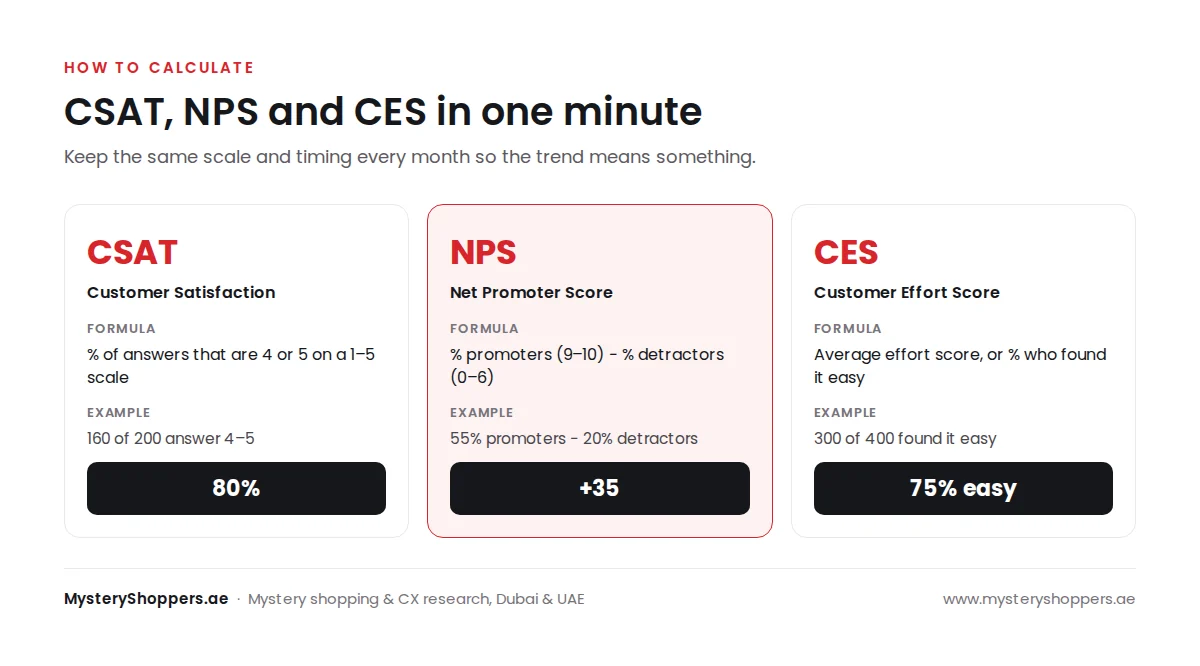
- CSAT: the percentage of customers who answer 4 or 5 on a 1–5 scale. If 160 of 200 respondents choose 4 or 5, CSAT is 80%.
- NPS: the percentage of promoters (9–10) minus the percentage of detractors (0–6) on the 0–10 scale. It ranges from −100 to +100.
- CES: the average score on the effort question, or the percentage who found the task easy or very easy.
Customer satisfaction surveys in the UAE: practical tips
- Offer Arabic and English as a minimum. Many UAE businesses also add Hindi, Urdu, Russian or Chinese for specific customer groups.
- Send the survey where customers already are. A WhatsApp link or a QR code at the counter usually gets more responses than a long email; see our QR-code feedback service.
- Ask within 24 hours of the visit or purchase, while the experience is fresh.
- Ask for consent before using contact details for marketing, and keep survey data secure.
- Report results by branch, channel and staff team, not only as one company score.
Common mistakes
- Surveying only happy customers, for example by asking staff to hand out forms selectively.
- Changing the questions every month, so trends cannot be compared.
- Collecting scores but never reading the open comments.
- Not closing the loop: a customer who reports a problem and hears nothing back is often lost.
- Relying on surveys alone. Surveys tell you how customers feel; mystery shopping vs customer satisfaction surveys explains why many businesses pair them with mystery shopping to see what actually happened.
Need help running your survey?
We design and run customer satisfaction surveys for UAE businesses in Arabic and English, from question design to dashboards that show which actions will move your score. Request a proposal and tell us what you want to learn.
Frequently asked questions
How many questions should a customer satisfaction survey have?
Usually between three and ten. A short survey of about six questions gets more responses and still gives you a headline score, the reasons behind it and one clear improvement.
What is the best scale for customer satisfaction questions?
A 1–5 scale is the most common for satisfaction and effort, and the 0–10 scale is standard for the recommendation (NPS) question. Keep the same scales over time so results can be compared.
What is a good CSAT score?
It depends on the industry and on how the question is asked. Compare your score with your own previous results and between your branches first; a steady improvement matters more than a single number.
What is the difference between CSAT, NPS and CES?
CSAT measures satisfaction with a specific experience, NPS measures how likely customers are to recommend you, and CES measures how easy it was to get something done.
How can I increase survey response rates?
Keep the survey short, send it within a day of the experience, use the channel customers prefer such as WhatsApp or a QR code, offer Arabic and English, and tell customers how their feedback is used.
Let's talk
Ready to see what your customers really experience?
Request a corporate proposal or book a CX consultation with our team.