
Net Promoter Score, or NPS, is one of the most widely used customer experience measures in the world. It is based on a single question: how likely are you to recommend us to a friend or colleague? The simplicity is its strength and its weakness. On its own, the number tells you little; used properly, with the reasons behind it and a clear process for acting on them, it becomes a practical tool for improving service. This guide explains how to calculate NPS, how to interpret it and how to raise it.
Customer Experience
Net Promoter Score (NPS): How to Calculate It, What a Good Score Is and How to Improve It
10 min read·16 October 2026·
What is Net Promoter Score?
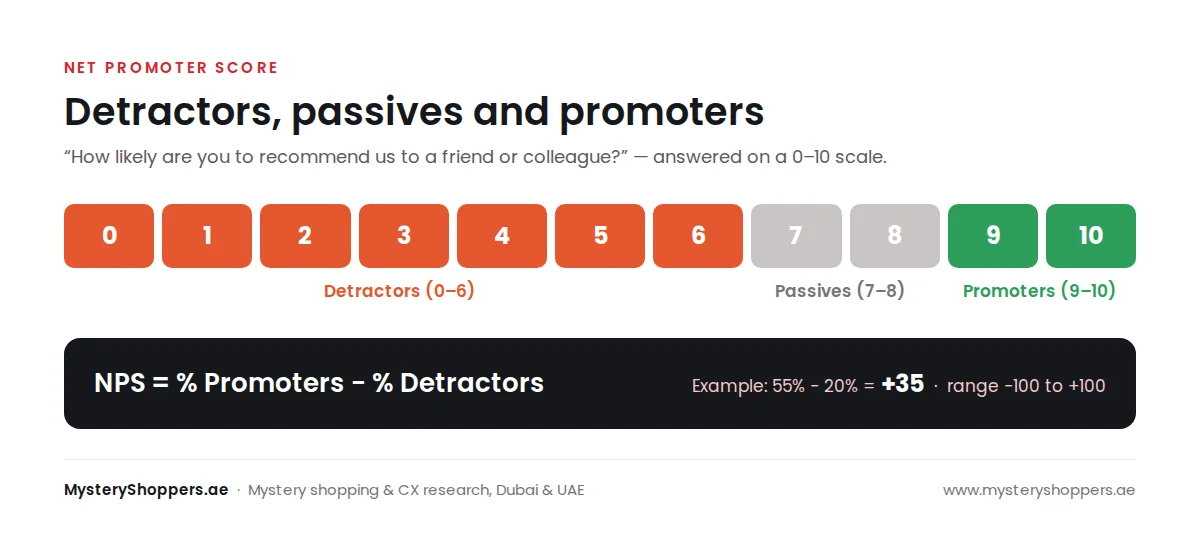
NPS was introduced by Fred Reichheld of Bain & Company in a 2003 Harvard Business Review article, and Net Promoter is a registered trademark of Bain & Company, Fred Reichheld and NICE Satmetrix. Customers answer one question on a 0–10 scale and are grouped by their answer:
- Promoters (9–10): enthusiastic customers who are likely to buy again and recommend you.
- Passives (7–8): satisfied but not enthusiastic; they may switch if a competitor offers more.
- Detractors (0–6): unhappy customers who may complain, leave poor reviews or stop buying.
How to calculate NPS
NPS = percentage of promoters − percentage of detractors. Passives count towards the total number of responses but are not added or subtracted.
Worked example: 400 customers answer. 220 give a 9 or 10 (55% promoters), 100 give a 7 or 8 (25% passives) and 80 give 0 to 6 (20% detractors). NPS = 55 − 20 = +35. The score is written as a whole number, not a percentage, and can range from −100 to +100.
What is a good NPS?
Any score above zero means you have more promoters than detractors. Beyond that, a "good" score depends heavily on the industry, the country, the channel and how the survey is run, so published averages from other markets are a weak benchmark. The most useful comparisons are:
- Your own trend over time, measured the same way.
- Your branches, channels or teams against each other.
- Your score against direct competitors, measured with the same method, for example through competitor benchmarking.
Relationship NPS and transactional NPS
- Relationship NPS asks about the brand as a whole, usually once or twice a year. It shows overall loyalty.
- Transactional NPS asks straight after an interaction, such as a visit, delivery or service call. It shows which touchpoints create promoters and detractors, and it is the version branch managers can act on.
The follow-up question that makes NPS useful
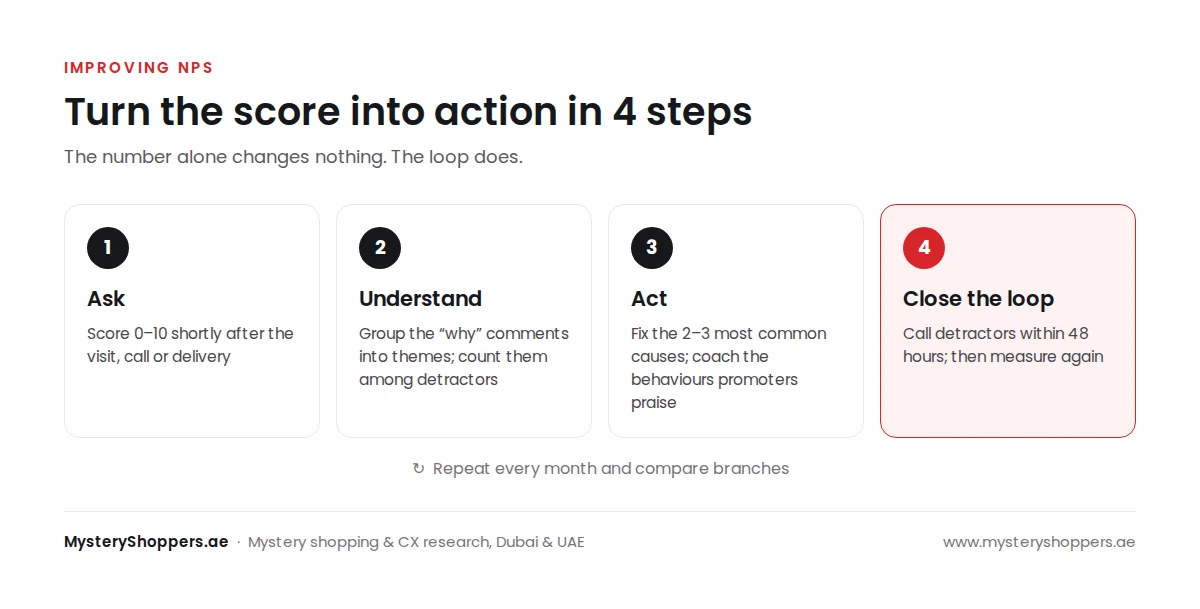
Always ask why. "What is the main reason for your score?" turns a number into a list of causes. Group the comments into themes such as waiting time, staff attitude, price, product availability or follow-up, and count how often each theme appears among detractors and promoters. The themes most common among detractors are where to start. Our list of customer satisfaction survey questions includes other follow-up questions you can add.
How to improve your NPS
- Close the loop with detractors quickly. Contact unhappy customers within a day or two, fix the issue where possible and record what happened.
- Fix the most common causes, not the loudest complaint. Use the comment themes to choose two or three priorities a quarter.
- Train for the behaviours promoters mention. Comments from promoters usually describe specific moments: a warm greeting, a clear explanation, a follow-up call. Those are the behaviours to coach.
- Check what actually happens on the ground. Customers describe how they felt; mystery shopping shows what staff actually did, so you can see why scores differ between branches. Read how mystery shopping can improve NPS.
- Remove effort. Long waits, repeated explanations and slow replies on WhatsApp create detractors in almost every industry.
- Share results with frontline teams every month, including positive comments, so they see the score as feedback rather than surveillance.
Common NPS mistakes
- Asking only selected customers, or asking staff to request high scores. Both make the number meaningless.
- Changing the question wording or timing, which breaks the trend.
- Reporting the score without the reasons behind it.
- Setting staff bonuses on NPS alone, which encourages gaming the survey.
- Comparing your score with averages from other countries or industries.
NPS in the UAE
UAE customers are multilingual and often reply on mobile, so offer the survey in Arabic and English and send it by WhatsApp, SMS or QR code shortly after the experience. Because many UAE businesses operate across several emirates and channels, report NPS by branch and channel, not just as one company number. Our team runs customer satisfaction and NPS surveys and Voice of Customer programmes that connect the score to the actions behind it.
Frequently asked questions
How do you calculate Net Promoter Score?
Subtract the percentage of detractors (scores 0–6) from the percentage of promoters (scores 9–10). Passives (7–8) are included in the total but not in the calculation. The result ranges from −100 to +100.
What is a good NPS score?
A positive score means you have more promoters than detractors. Whether a score is good depends on your industry and how you measure, so compare it with your own trend, your branches and direct competitors measured the same way.
How often should we measure NPS?
Transactional NPS can run continuously after each interaction. Relationship NPS is usually measured once or twice a year.
What is the difference between NPS and CSAT?
NPS measures willingness to recommend and is a broad indicator of loyalty. CSAT measures satisfaction with a specific interaction. Many businesses track both.
Can NPS be measured in Arabic?
Yes. The question works in any language, and in the UAE offering both Arabic and English usually improves response rates and makes the results more representative.
Let's talk
Ready to see what your customers really experience?
Request a corporate proposal or book a CX consultation with our team.