
Customer service standards turn good intentions into clear expectations. "Give great service" means something different to every employee; "greet every customer within 30 seconds" does not. This guide explains what customer service standards are, gives 25 measurable examples across the main channels, shows how to write standards that fit your brand and explains how to check that every branch and team actually follows them.
UAE Service Quality
Customer Service Standards: 25 Examples and How to Set Them for Your Team
10 min read·16 October 2026·
What are customer service standards?
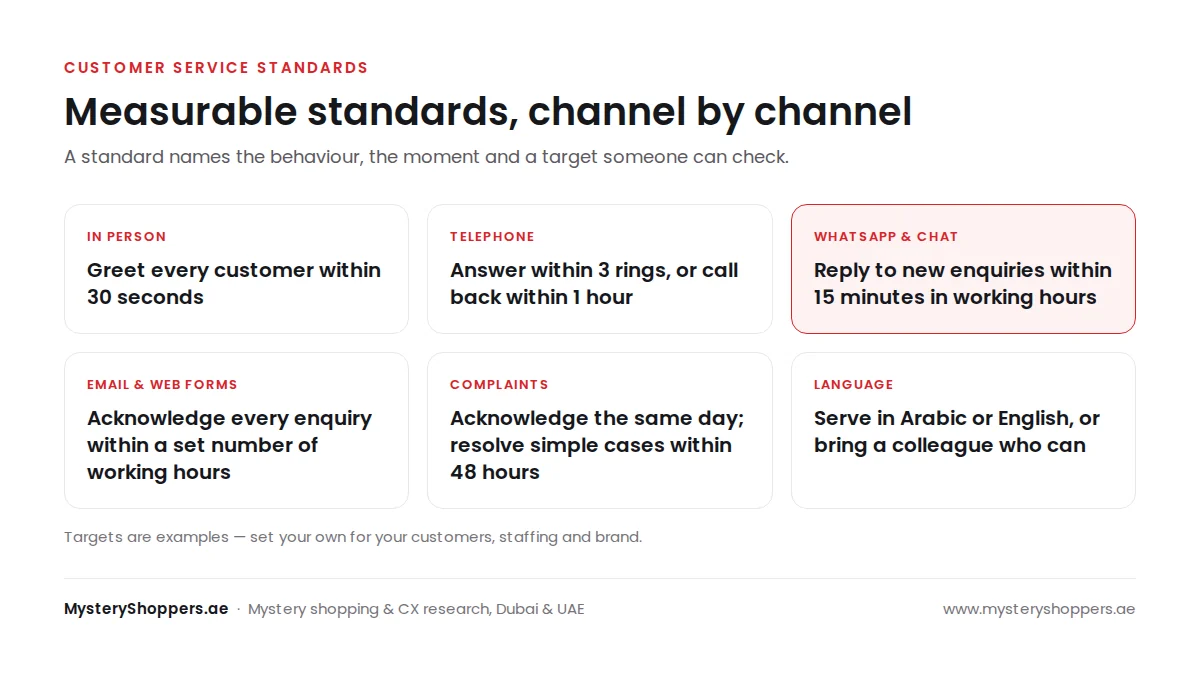
Customer service standards are specific, observable rules that describe how your team should serve customers. Good standards have three parts: the behaviour, the moment it applies to and a measurable target. They sit between your brand values, which are broad, and your procedures, which describe tasks step by step.
What makes a standard work
- Specific: it describes an action, not an attitude.
- Measurable: someone can check whether it happened, for example with a time, a count or a yes or no.
- Realistic: the team can meet it on a busy day, not only on a quiet one.
- Linked to customers: it improves something customers care about, such as speed, clarity or feeling valued.
- Owned: someone is responsible for training, measuring and reviewing it.
25 customer service standard examples
The targets below are examples. Set your own based on your customers, staffing and brand.
In person
- Greet every customer within 30 seconds of entering, even when busy.
- Make eye contact and smile when greeting.
- Ask at least one open question to understand the customer's needs.
- Explain prices, offers and terms clearly before payment.
- Offer further help before the customer leaves.
- Thank the customer and invite them back.
Telephone
- Answer calls within three rings, or call back within one hour if missed.
- Use the agreed greeting with the business and staff name.
- Never transfer a caller without explaining who they will speak to.
- Confirm the customer's request and next step before ending the call.
WhatsApp and live chat
- Reply to new enquiries within a set time during working hours, for example 15 minutes.
- Send an automatic reply outside working hours stating when a person will respond.
- Use the customer's name and avoid one-word replies.
- Follow up within 24 hours if the customer has not replied to a quote or offer.
Our guide to WhatsApp customer service in the UAE covers response standards in more detail.
Email and web forms
- Acknowledge every enquiry within a set number of working hours.
- Answer the question asked, with a clear next step.
- Sign off with a name and direct contact details.
Complaints
- Acknowledge every complaint the same day.
- Apologise for the experience without arguing about blame.
- Give the customer a named contact and a date for resolution.
- Resolve simple complaints within 48 hours.
- Confirm with the customer that the issue is resolved before closing it.
Language and inclusion
- Serve customers in Arabic or English, or bring a colleague who can.
- Offer assistance proactively to elderly customers and people of determination.
- Respect cultural and religious considerations in greetings and service, including during Ramadan.
How to set customer service standards for your business
- Map the customer journey and list the moments that matter most, such as the first reply, the greeting, the explanation of price and the follow-up. Our customer journey mapping guide shows how.
- Ask customers and frontline staff what good service looks like at each moment.
- Write one or two standards per moment, using specific actions and targets.
- Check the targets against staffing and peak times, so they are achievable.
- Train every team member and include the standards in onboarding.
- Review the standards every year, or after a major change in your business.
How to check that standards are followed
- Mystery shopping checks behaviour as customers experience it, in person, by phone, on WhatsApp and online.
- Customer surveys show whether customers notice the standards. See our customer satisfaction survey questions.
- Operational data, such as call answer rates and response times, shows whether speed targets are met.
- Regular customer service assessments turn the results into coaching for each team.
Our guide on how to measure customer service quality explains how to combine these sources into one view.
Making standards stick
Standards fail when they are written once and filed. They work when managers talk about them every week, when staff see their own results, when good performance is recognised, and when training focuses on the standards that are most often missed. Our customer service training programmes are built around the gaps that mystery shopping and surveys reveal.
Frequently asked questions
What are customer service standards?
They are specific, measurable rules that describe how your team should serve customers at each stage of the experience, such as how quickly to greet, how to answer the phone and how to handle complaints.
How many customer service standards should a business have?
Enough to cover the moments that matter most, usually between 10 and 30. Too many standards are hard to train and impossible to measure consistently.
What is an example of a measurable service standard?
"Reply to every new WhatsApp enquiry within 15 minutes during working hours" is measurable. "Be responsive on WhatsApp" is not.
How do you measure customer service standards?
Combine mystery shopping for staff behaviour, customer surveys for perception and operational data for speed and volume, and report the results by branch and team.
Should service standards be the same in every branch?
The core standards should be the same so customers get a consistent brand experience. Targets can be adjusted where branches have very different customer volumes or services.
Let's talk
Ready to see what your customers really experience?
Request a corporate proposal or book a CX consultation with our team.